SEO/GEO Specialist and Content Marketing Manager for SaaS, e-commerce and other online projects. I drive the organic growth of brands and websites, from search engine results to AI answers.
senior seo specialist saas
gianpierospelozzo.it › en
Gianpiero Spelozzo – Senior SEO Specialist for SaaS
Over eight years of SEO and content marketing, in-house and as a consultant. I set up SEO at Osservatori Digital Innovation and led GetResponse’s European markets, up to brand visibility in AI answers.
About meFor over eight years I have worked in SEO and content marketing, with both in-house and independent consulting experience. I set up SEO at Osservatori Digital Innovation and led SEO for GetResponse's main European markets, also working on brand visibility in ChatGPT, Gemini and AI Overview answers. I collaborate with the University of Macerata, where I teach annual courses on SEO and digital marketing.
Some numbers
+644%
monthly organic visits in 3 years, at Osservatori Digital Innovation
+162%
conversions on GetResponse Italy's AI products, after repositioning the brand ahead of the competitors
4 markets
managed at GetResponse, training an in-house team of local editors
International SEO content strategy, brand visibility in LLMs and AI Overviews, performance analysis, projects in collaboration with the Marketing, Design and Product teams.
2022–2024
SEO Country Manager Italy
GetResponse · Full remote (Ortona – Gdańsk)
Content strategy for the Italian market, off-site visibility and PR projects, coordination of freelancers, experts and local web publications.
2021–present
Guest lectureralongside
University of Macerata · Macerata
Seminars and lectures on SEO and digital marketing for students and master’s programmes.
2018–2022
SEO Content Manager
Osservatori Digital Innovation · Milan
SEO strategy, technical and content optimisation, search intent analysis, reporting.
2017–2018
Junior Content Editor
Milan Chamber of Commerce · Milan
Managing and developing content for the institutional website, the intranet and newsletters.
2015–2017
Junior SEO Copywriter
Lumidigital · Tallinn (Estonia)Bricoflor · Wuppertal (Germany)
Support for the SEO activities of a web agency, and SEO and content marketing for bricoflor.it.
Case studies
Each case study describes the methodology followed, the opportunities and main risks, the results achieved and the takeaways from each project.
For companies
Positioning GetResponse as an AI tool (before the competitors)
GetResponse Italy, 2023–2024. Strategy, content optimisation and link building.
+161.7%
verified free accounts (VFT)
+68%
organic sessions to the page
The signal
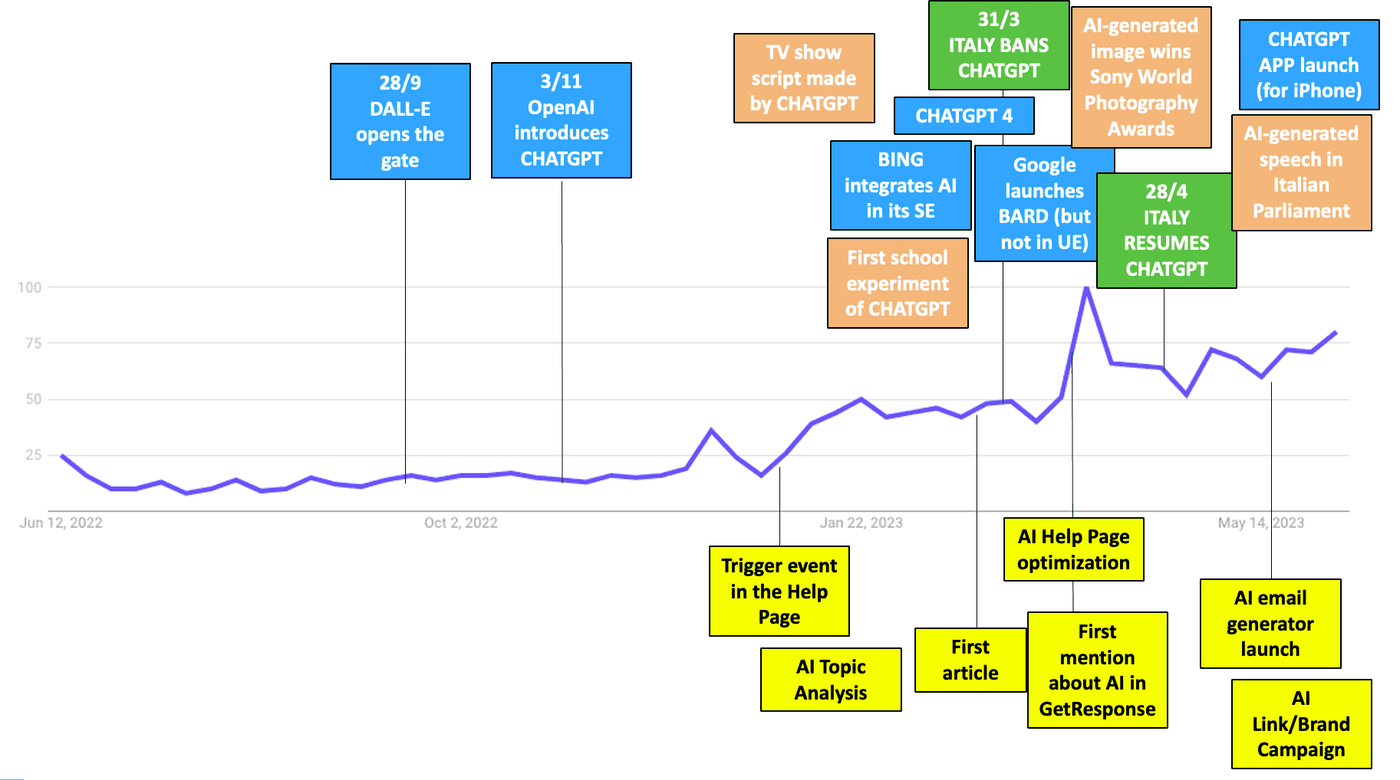
In 2023 a help-centre page, “How to create a website with AI”, written to support customers and not for SEO, starts receiving traffic and conversions from Google after a long period of inactivity. With ChatGPT, the way people search for AI has changed: before, they searched to understand it; now they search for how to use it to get things done. Between January and June 2023 the page becomes the second page of the Italian site for visits and conversions from Google.
Interest in AI in Italy (June 2022 – May 2023), with market events and, in yellow, GetResponse's SEO actions.
What I did
Read the demand. I reconstructed how searches about AI changed (from 2018 to 2023) and mapped the sub-topics, with the intent maturity stage of each.
Optimised the help page. From a service page to a page that acquires new users: added context on ChatGPT alternatives, reviewed internal links, reviewed quality, added CTAs to the product pages.
Planned seven articles on AI, choosing the topics closest to GetResponse's products, with the related content briefs. The articles were commissioned from Italian AI experts to leverage the E-E-A-T approach.
Supported the content with links: interviews, guest posts, external reviews and placements.
verified free accounts (VFT) after optimising the service page (period: 3 months compared with the previous period)
+68%
organic sessions to the service page over the same period
38%
share of the blog in organic traffic in September 2024, versus 8% in January 2023
70%
of blog traffic from AI-related articles (period: October 2023 – October 2024)
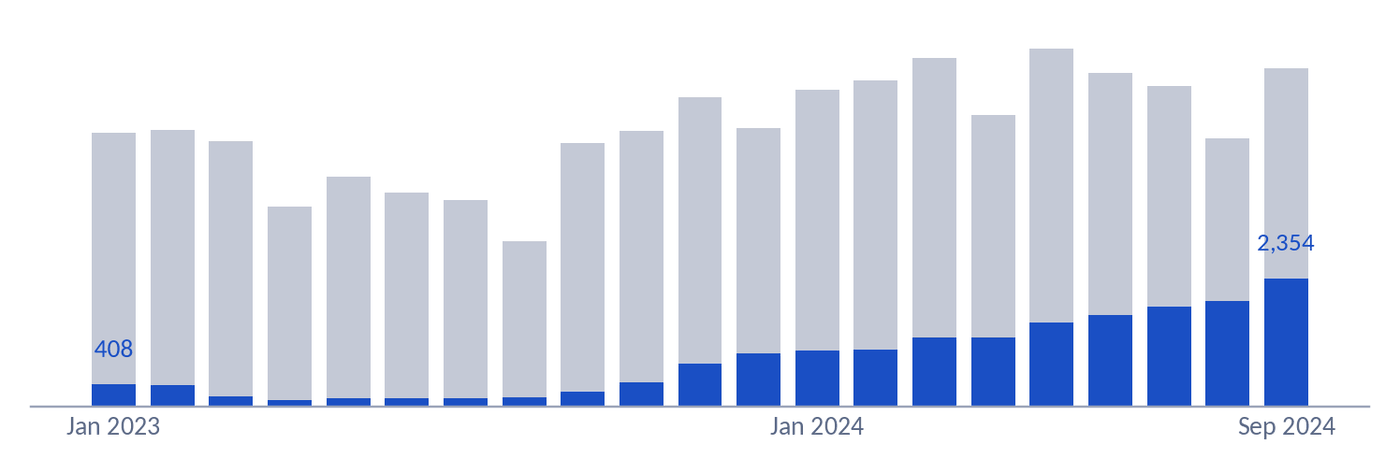
Monthly sessions from search engines, January 2023 – September 2024: whole site (grey) and blog (blue).
From January 2023 to September 2024, the blog's monthly sessions from search engines grew by 477% and its monthly conversions (users who activated a GetResponse account) by 283%. An article on the best artificial intelligence sites became the most visited of the year. After the period under analysis, the same article kept position zero for searches about AI tools and, from 2025, kept a steady presence in AI Overview, so much so that competitors and other similar vendors repeatedly asked me to be mentioned in that article.
Having anticipated the market
With this strategy I repositioned GetResponse as an AI tool early: shortly afterwards, all competing software would integrate AI into their products, but we were already present in searches on this topic. Brand searches for “ai getresponse” also developed early. In this sense I did not only intercept demand: I helped create a new one, tied to the brand.
Source: GetResponse internal data, 2023–2024.
For companies
SEO or GEO? A brand's visibility in AI answers
GetResponse, 2025–2026. An experimental project that most would call GEO: how I measured the sources of AI answers and adapted GetResponse's global SEO strategy.
≈25%
share of voice on ChatGPT and Gemini
168
articles selected for optimisation
Goal and hypothesis
Improve the brand's visibility and positioning in ChatGPT, Gemini and AI Overview answers. LLMs build purchase-related answers from a limited set of sources: by working on those sources and on owned content, the chances of being cited and recommended increase.
Step 1. Building the measurement system
Periodic monitoring on ChatGPT and Gemini, with purchase prompts grouped into 13 thematic areas. Metrics: share of voice, share of mentions, sentiment and cited domains.
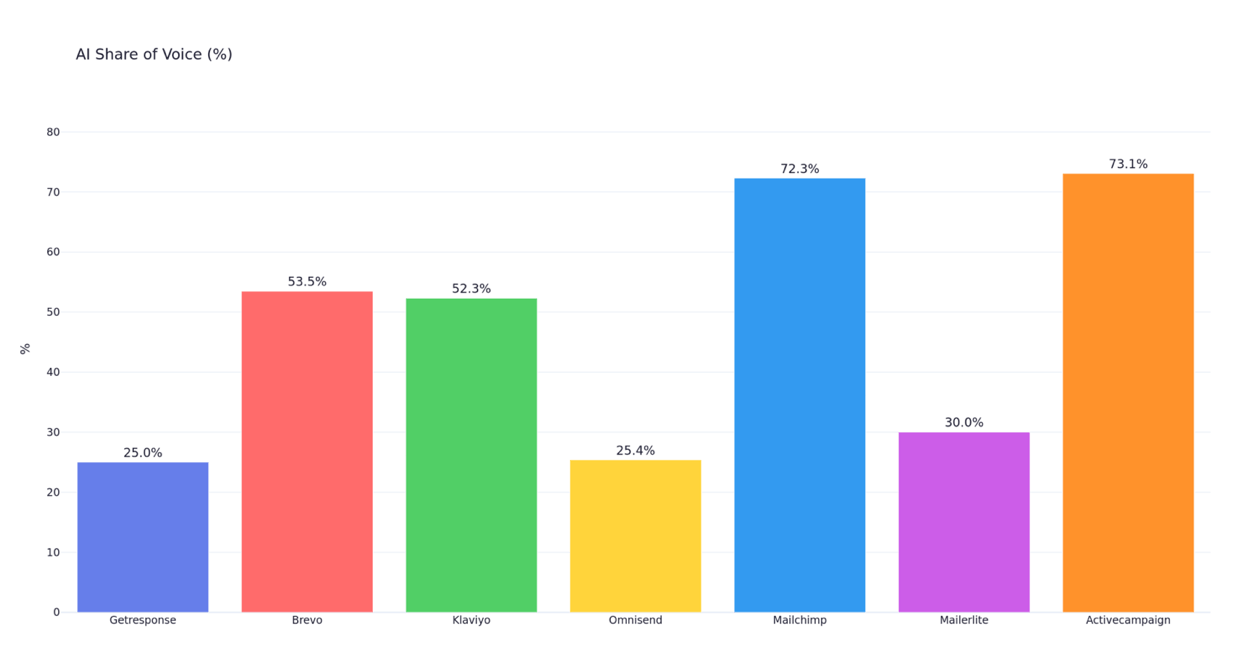
In May 2026, across 260 runs, share of voice was about 25%, still far from the category leaders, up 1.0 percentage points on the previous month. Higher on Gemini (28.5%) than on ChatGPT (21.5%).
AI share of voice by brand, May 2026.
Strong thematic areas: Lead generation (45%) and Email marketing (30%). Weak areas: CRM and Lifecycle automation (10%).
Caveat: with two runs a month, changes in individual areas may be statistical noise.
Step 2. Covering the most-cited sources
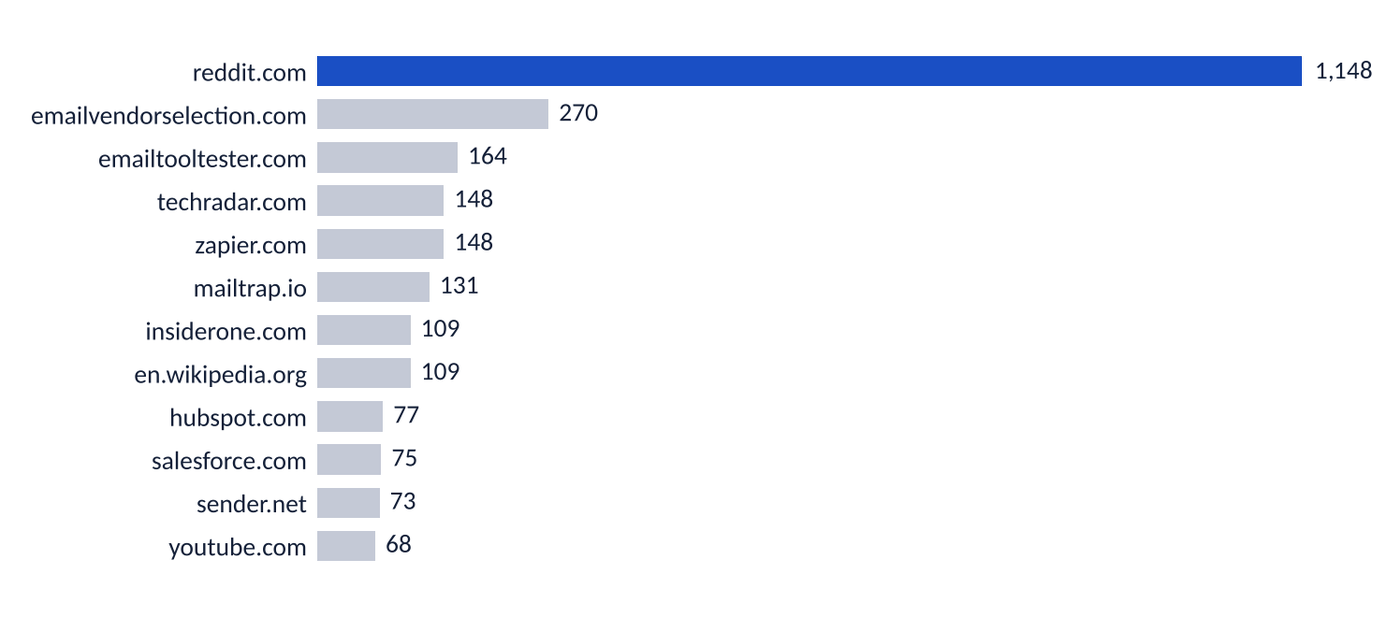
The system also shows where LLMs take their information from. Among the most-cited domains in the answers to the monitored prompts, Reddit leads, followed by comparison and review sites, technical blogs and Wikipedia.
Most-cited domains in the answers to the monitored prompts (top 12). Source: GetResponse internal data.
Reddit is by far the most-cited source, with more than four times the citations of the second: it received dedicated work, in two phases.
Thread comments (2025). About 30 comments a week on threads chosen for ranking and engagement, plus Quora for Italy. In three months: 131 mentions on Reddit (1,546 views) and 58 on Quora (4,447). Then Reddit introduced a very aggressive ban policy against marketing in comments and this route closed.
Posts from LLM queries (2026). I collected fan-out queries, i.e. the searches LLMs run before answering: 1,863 unique queries collected over 7 runs. From these I derived 14 post ideas, to be published from a new dedicated account, starting from the topics with the most demand and the least Reddit presence.
After 24 hours, the first post had already been cited 7 times and became the eighth most-cited Reddit post among the monitored prompts.
Beyond Reddit From the study of the most-cited sources I compiled a list of sites where the brand's presence needed improving, mainly listicles, comparison sites and thematic blogs. On some, GetResponse was not present; on others it appeared too low or with outdated product information. I passed the list to the Brand and PR teams, because it was not simple link acquisition but brand communication on those sources.
Step 3. Optimising owned content
I selected 168 articles across the English, German, Italian and Spanish blogs, based on decline in clicks, opportunities in striking distance, topic importance and content type, and assigned each one of four optimisation frameworks: 1) light optimisation, 2) enrichment with answer capsules, 3) advanced rewriting, 4) strengthening of comparison articles. AI produces modular blocks (FAQs, tables, answer capsules, schema markup, other elements) and the local editor integrates them while keeping editorial control. To make the process repeatable I designed a framework with agents.
Light blue: AI agent. Green: human intervention.
1. Brief preparation
Manual inputsOriginal article, competitor pages, SERP, People Also Ask and AI Overview, SEO guidelines, product knowledge
SERP-SEO Brief builderThe agent generates the brief
SEO brief and gap analysisWhat the article is missing compared with the Brief builder's analysis
2. Choosing the path
New article or deep rewriteThe brief goes to an external writer
Light refinementCondensed brief, article code, SEO rules and product knowledge go to the pipeline
3. Refinement pipeline
1 ParserConverts the article into a map of blocks
2 DiagnosticsAssigns each block the required action
2.5 Merge and batchPrepares the working table and splits it into batches
3 RewriterRewrites one batch at a time
4 ValidatorChecks the blocks against the rules
5 AssemblyHuman editorial review in WordPress
This step was under way when I left the company: I do not have enough data on the results, so I present it as a methodology project.
Learnings
Measure first. The system showed where the brand was missing and that AIs (ChatGPT, Google AI Overview, …) can behave differently, and it guided the following choices.
Sources matter as much as owned content. LLMs mainly cite communities, comparison sites and thematic blogs: covering them requires work that is different from on-site SEO and also different from classic off-site. It requires the full involvement of Brand and PR.
On Reddit, marketing in comments is penalised. What works is content based on experience and specific numbers, and posts from authoritative accounts (even better if they are channels managed by the brand itself).
LLM fan-out queries are a source of ideas. They help to understand how to optimise your own content and which content to create on other platforms.
What I would have improved. 1) more runs per month; 2) per-domain attribution of sources; 3) before-and-after measurement on a small sample of articles, before scaling fully to more than 100 articles (not possible because of the board's decisions).
Source: data and analyses produced by me for GetResponse, 2025–2026.
For companies
[Cheap] International SEO: Expanding multiple local blogs… on a limited budget
GetResponse, European markets, 2024–2026. Multi-market analysis, training and editorial process across Italy, Germany, Spain and France. Localisation plan from January to June 2026. I no longer have access to the final data: I report the observed trend and the learnings.
4
markets: Italy, Germany, Spain, France
4
customer care staff trained as local editors
Starting point
With few resources and no budget, it was not possible to apply broad strategies in every market. I first analysed each market (organic trend, local blog performance, content clusters, coverage compared with competitors) to understand where a light-touch intervention could be enough.
Trend. The decline in sessions and account activations followed the lack of dedicated resources and, from mid-2025, AI Overviews added their effect on non-brand searches. Brand searches held up better: unaffected by AI Overviews, they still lead to the pages that convert best.
Clusters. Content on Affiliate marketing and Monetisation brought the most users and free trials, followed by listicles and tool comparisons. Topics such as landing pages and lead generation had a smaller impact.
Markets. Germany was the most competitive, with very strong local players. Spain had the biggest coverage gap. Italy was a balanced market, with room to manoeuvre in clusters such as E-commerce and Automation. France had never had any SEO work: to be developed from scratch.
Competitor models. Localising article by article wins more visibility where competition is local; translating a global architecture holds up on the more universal topics. With our resources, the second model was the only realistic one.
The idea
Use the blogs as a low-cost lever: localise the articles that already work on the English blog, to bring relevant organic traffic in the analysed clusters even in lower-priority markets, but with interested users.
What I did
Selection. I identified the best articles, starting from the English blog, by traffic and potential in the clusters that brought the most organic conversions.
Training. I trained four members of the customer care team, the local editors, who spoke the languages of the markets, in basic SEO. They were all native speakers, except for French.
Plan. I prepared a monthly plan of articles to localise for the local editors, from 10 to 15 articles a month in total, depending on each person's availability.
Process. Machine translation with the DeepL plugin integrated in WordPress, then proofreading and insertion of the basic SEO elements learned in the training.
What happened
Market
Starting point
Observed trend
Spain
Biggest coverage gap
Very strong growth
France
No previous work, from scratch
Strong growth within a few months (January–June 2026)
Italy
Balanced market
After the 2025 drop caused by AI Overviews, stable, then rising again in 2026 without regaining earlier levels
Germany
The most competitive, with local players
Did not take off
Comparing the first quarter of 2026 with the last quarter of 2025, Spain and France were growing strongly. I no longer have access to the final data, so I do not report percentages.
Learnings
Light localisation works where local competition is low. In Germany a reviewed translation is not enough: a more localised and technically deeper strategy is needed.
Where there was nothing, reusing already-validated content gave the fastest response. That was the case in France.
Choosing the articles matters as much as translating them. I prioritised the clusters that brought the most conversions, not those that were easiest to translate.
Training people already in the company expands editorial capacity without new budget, provided there is a simple, repeatable process with quality control.
Non-brand traffic remains exposed to AI Overviews. Listicles and comparisons should also be structured for AI answers.
What I would have done next. Measure each market against a clear baseline, review the clustering criteria and dedicate a specific plan to Germany.
Source: GetResponse internal analyses, 2024–2026.
For companies
From zero to SEO: the organic growth of Osservatori Digital Innovation
Osservatori Digital Innovation, 2018–2021. Editorial SEO strategy, pillar content and lead generation.
+644%
monthly organic visits
+506%
first-page keywords
Starting point
The Osservatori produce high-level research on digital innovation, but that material was not designed to be found on Google. The e-commerce site, a container for events and products, had a structure that was not very SEO-friendly and little topical depth on individual themes. And the research teams first of all had to be “acculturated” to SEO, in order to turn their work into assets that drive traffic. At the start there was no SEO team or project, only a basic idea about the potential of the organic channel: the person in charge of connecting the dots was me.
What I did
Separated the roles of the sites. The e-commerce site ranks for branded and transactional keywords and for the Osservatori research. The blog becomes the heart of the content strategy and intercepts informational searches on the research topics, from high-volume keywords to long-tail ones.
Built a pillar and cluster system. For the 30 hottest research topics I had a digital guide produced: a pillar piece that covers the full search intent of the topic and branches into in-depth articles on the sub-topics.
Designed the conversion funnel. Each piece carries progressive CTAs: free report (popup after 10 seconds), freemium product, targeted product, paid programme.
Set up the method. Keyword types and long tail, one intent per page, competitor and SERP analysis, topic modelling and standards for title, description, URL and headings.
Involved the research teams. First synergies on content; after the first successful experiments, we recalibrated internal resources for copywriting, design of the guide pages and outreach to publications, for links and the transfer of authority.
Trained the researchers with periodic sessions, so they could directly produce content with strong SEO value.
Managed the site migration with redirects for over 18,000 URLs.
Worked on links with digital PR: in 3 years we obtained 561 links and 1,602 mentions in the most important Italian online publications.
Results
+644%
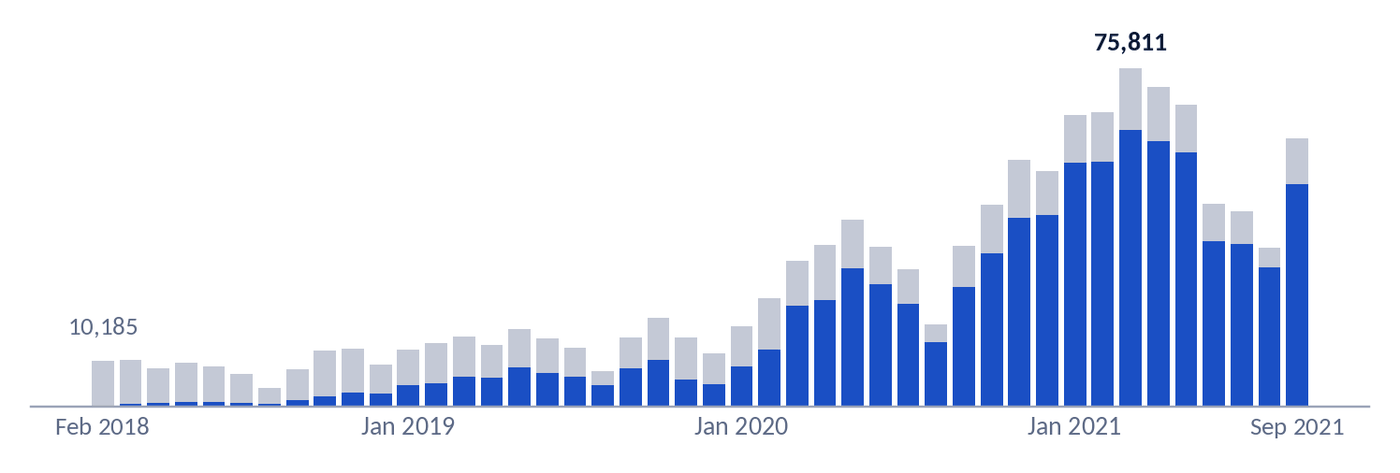
monthly organic visits, from 10,185 (February 2018) to 75,811 (March 2021)
2% to 88%
share of the blog in organic traffic, from February 2018 to August 2021
22% to 60%
weight of SEO in the site's total traffic, over the same period
+506%
first-page keywords, from 554 (January 2019) to 3,355 (September 2021)
23,475
leads generated by the blog between April 2019 and September 2021
Monthly visits from search engines, February 2018 – September 2021: total (grey) and blog (blue).
In the March 2021 peak the blog brought 62,033 organic visits out of 75,811 in total, and more than half of its leads came from organic traffic.
What I took from it
I started from a site that was mostly a showcase of events and products, set up the foundations from scratch and then led the growth. The result is an ecosystem of blogs and online guides able to compete, on digital innovation topics, with the main vertical web publications and, on several topics, to outrank them. After the first results the work became a team effort, with research, copywriting, design and PR using a shared method.
Source: Osservatori Digital Innovation internal data, 2018–2021.
For clients
Local SEO for a dermatology practice: from website to bookings
Abruzzo and Marche. Website, copywriting and SEO, May–October 2026. Technology: Astro and Vercel.
465
clicks from Google in six months
+174%
impressions in AI answers
The brief
The doctor sees patients at several practices across Abruzzo and Marche. The goal was a website that clearly presented treatments and specialisations and made it easy to book a visit at the most convenient location.
What I did
A structure built around booking. Each treatment has its own “Book a visit” button, linked to the online calendar on MioDottore.
Trust first. Verified patient reviews and an “About me” page on her professional background.
Contact in one step. A “Request information” form with type of visit and contact details, plus an FAQ section on the most common questions.
Fast and findable. Static site in Astro on Vercel, optimised for mobile and for local search.
Results of the first six months online
465
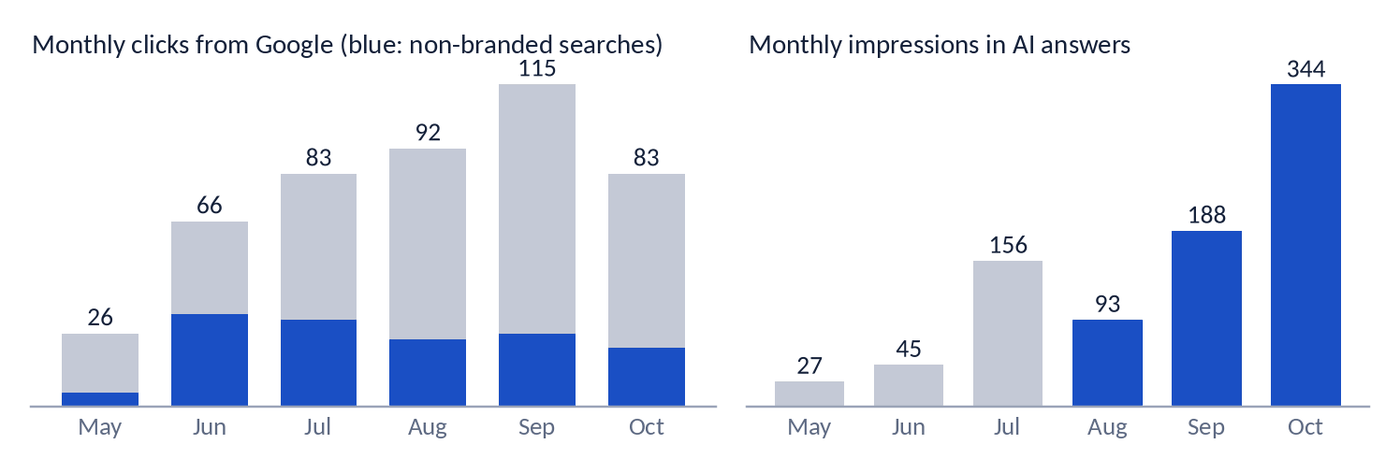
clicks from Google, +66% in the last three months compared with the first three
4,6
average position: consistently on the first page
30%
of clicks (140) from non-branded searches, i.e. from patients who did not yet know the doctor
+174%
impressions in AI answers (853 in total), same quarter-on-quarter comparison
Monthly clicks from Google (blue: non-branded searches) and monthly impressions in AI answers, May–October 2026.
Source: Google Search Console, May–October 2026. Monthly values rounded.
Brand searches, i.e. those with the doctor's name, grew by over 300% up to September 2026. Non-branded searches peaked between June and July and then levelled off.
What I learned and next steps
Brand searches measure word of mouth; non-branded searches bring new patients. It is the latter that need to grow, because after the June–July peak they have levelled off.
Nearby towns have room to grow. Next steps: pages dedicated to the neighbouring towns from which the professional can draw new clients, more effective titles and descriptions for searches with many impressions and few clicks, more weight on the word “dermatologa” (dermatologist).
AI answers are growing faster than the other channels and should be monitored every month.
Coming soon
Slowride Cicloturismo
A bike-touring and cycling-travel blog (in Italian), active since 2020. The case study is coming soon.
Note. This portfolio collects five case studies. Since I have mostly worked in-house, some report percentage changes or the observed trend rather than absolute values, which belong to the companies. Where I do not have data available, I say so.
SEO for SaaS and e-commerce, international SEO, local SEO, on-site and off-site, GEO/visibility in AI answers, content strategy.
Education and languages
Master's degree in Public, Corporate Communication and Advertising (2016) and bachelor's degree in Mass Communication Sciences (2013), University of Macerata. Italian native speaker, fluent English, intermediate Spanish.